Reframing Our Awe of Nature to Help Save the Environment
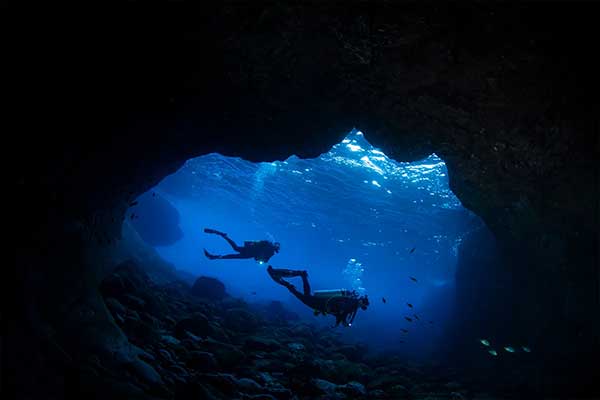
Divers who live and work in underwater habitats report a wondrous sense of connection to the marine environment. Getty Images
A recent study on the connection between living underwater and environmental consciousness has been published with the help of MES/CEE Professor Mark Patterson, CEE Affiliated Faculty Brian Helmuth, and CEE Affiliated Professor Geoffrey Trussel. With the help of an assisting PhD student, they interviewed and recorded the behavior of aquanauts-those that experiment and spend large amounts of time under the water. Findings claim that aquanauts experience an “underview effect”, a cognitive shift that deepens the connection and commitment to their research.
This article originally appeared on Northeastern Global News. It was published by Cynthia Hibbert.
How living and working under the sea fills aquanauts with wonder and awe. The phenomenon is called the “underview effect.”
The feeling of awe and planetary connection experienced by astronauts observing Earth from low space orbit is known as the “overview effect,” a term coined by Frank White, the author of numerous books on space exploration and science.
Now researchers from Northeastern University have documented a similar cognitive shift among aquanauts, people who live and work under the sea, which they are calling the “underview effect.”
Sharing that sense of wonder and kinship with nature with the public could be key to helping understand and conserve the ocean environment, according to the research published in Environment & Behavior, an interdisciplinary journal on relationships between environments and human behavior.
“We’re at this juncture where we’re realizing that a business-as-usual approach to how we interact with nature and especially the ocean is just not going to cut it,” said Brian Helmuth, marine and environmental studies professor at Northeastern and one of the authors of the study.
With every other breath people take coming from a marine organism, using the ocean as a dumping ground without regard to its health, bodes ill not just for the planet but for humanity, he said.
“Unless we reframe the way we interact with the ocean, we’re in a lot of trouble,” Helmuth said.
 |
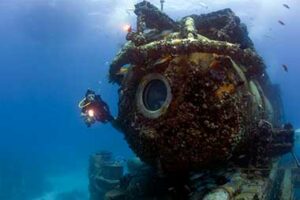 |
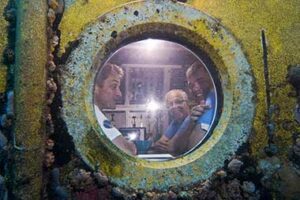
Left, aquanaut Fabien Cousteau with former provost Stephen Director and professor Brian Helmuth in Aquarius habitat during an outreach event to the Boston Museum of Science. Photo by Chris Marks. Right, The Aquarius underwater habitat in the Florida Keys. Photo by Kip Evans and courtesy of Fabien Cousteau/Mission 31
For the study, lead author Kristen Kilgallen, a third-year Ph.D. student at Northeastern, interviewed 14 aquanauts — one of whom is also an astronaut — about the psychological, behavioral and cognitive changes they experienced living underwater for extended periods of time.
“Aquanauts have been very understudied,” said Kilgallen, who said the research is the first of its kind to go beyond the physiological or safety implications of living underwater for days and weeks at a time, a phenomenon known as saturation diving.
What are aquanauts?
Aquanauts are individuals who live and work underwater, using special underwater labs as a home base. Because the pressure is equal inside and outside the underwater station, unlike in submarines, aquanauts can scuba dive outside for eight or more hours a day without needing to take a break to decompress.
“It means you have unlimited time living on the bottom,” said Helmuth, who has participated in a number of aquanaut missions.
Normally, scuba divers can only descend to a depth of 60 feet for 45 minutes before they have to resurface, which gives them limited time to observe the ebb and flow of ocean life, Kilgallen said. Saturation divers, on the other hand, pack their decompression into 24 hours at the end of their underwater stay.
Helmuth compared it to Jane Goodall, the world-renowned primatologist, being able to live in the forest and study chimpanzees, compared to being dropped in by helicopter for 30 minutes at a time.
Awe and transcendence
Even short trips underwater can induce feelings of awe and transcendence, as anybody who has scuba dived or snorkeled on vacation can relate. Being underwater for extended periods amplifies that effect manyfold, Kilgallen said.
“A major shift occurred that was very similar to what astronauts experience, the overview effect,” she said.
The aquanauts reported that living underwater led to heightened perceptions and an amplification of the sense of commitment and connectedness to the natural world, Kilgallen said. Of the respondents, 70% reported heightened awe and gratitude and 64% heightened engagement with their surroundings due to the challenge of living under the seas.
Read full story at Northeastern Global News