Northeastern Engineering Students Win National Title at WEFTEC 2026 Student Design Competition
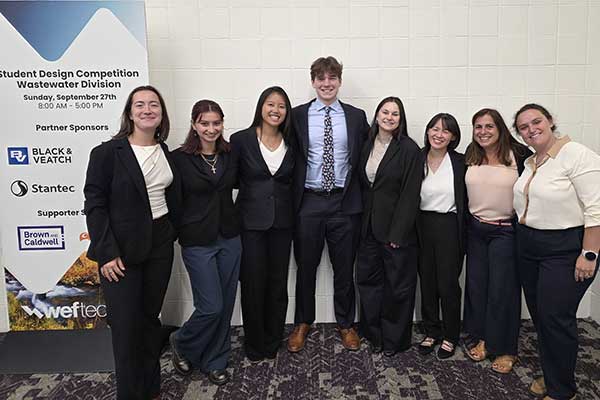
Team’s plan to modernize a small-town Maryland treatment plant, and put its treated water to work on athletic fields and a Christmas tree farm, takes top honors in New Orleans
A team of Northeastern University civil and environmental engineering students has won the 2026 Water Environment Federation (WEF) Student Design Competition. The competition was held September 27 at WEFTEC, the world’s largest annual water quality conference, at the Ernest N. Morial Convention Center in New Orleans.
The team presented as “A&E Consulting” and competed in the Circular Water Economy Division. Universities from across the United States, Canada, Puerto Rico, Mexico, and Costa Rica took part across the competition’s three divisions. Each team earned its place by winning a regional competition held by its WEF Member Association.
The team members are Sydney Scott (project manager), Sylvia Burns, Calvin Vasicek, Ingrid Alikaj, Chelsea Penetra, and Julia Ariano.
A real plant, a real problem
The team’s project responded to a request for proposals from the Town of Manchester, Maryland. The town runs a wastewater treatment plant built around two multi-function tanks installed in 1969 and 1988. The plant meets its current permit, but it faces three pressures: aging infrastructure, a growing population, and stricter nutrient limits expected under its federal discharge permit. Under the new limits, effluent sent to the local stream, Georges Run, would have to contain no more than 3 milligrams per liter of nitrogen and 0.3 milligrams per liter of phosphorus. Excess nitrogen and phosphorus feed algae blooms that degrade waterways and, downstream, the Chesapeake Bay.
The students designed a complete replacement facility that fits within the existing site. Its centerpiece is a 4-stage Bardenpho biological nutrient removal system. In this process, wastewater moves through alternating oxygen-free and oxygen-rich tanks, where microorganisms convert ammonia into harmless nitrogen gas. The team tested and refined the design using BioWin, an industry-standard process modeling software. They adjusted recycle rates and chemical doses until the modeled effluent met the nitrogen target.
To reach the much tighter phosphorus limit, the team added ferric chloride, which binds phosphorus so it can settle out. A cloth media filter then polishes the effluent. The full design also covers fine screening and grit removal, secondary clarifiers, aerobic sludge digestion, a volute dewatering press, and both UV and chlorine disinfection.
Turning wastewater into a resource
What set the design apart was its focus on reuse. The plant already sends part of its treated water to spray irrigation fields outside town. The team proposed treating effluent to a Class III reuse standard so it could serve new uses closer to home: about 0.12 million gallons per day each for Manchester Valley High School’s athletic fields and a local Christmas tree park, plus continued irrigation of nearby fields. They also developed a water reuse monitoring plan and made community engagement with the town a core project goal.
Building on a winning tradition
The team was advised by Professor Annalisa Onnis-Hayden and mentored by Emily Korot, a Northeastern civil and environmental engineering alumna now with CDM Smith. The team qualified for WEFTEC by winning the New England Water Environment Association’s Student Design Competition in May.
The victory caps a long run of success for Northeastern at the national competition under professor Onnis-Hayden’s guidance. Teams she has advised have earned two second-place and three third-place finishes, and this year’s team brought home the university’s first national title.