Liu to Lead New $1.2M Collaborative NSF Grant on Wildfire Emissions
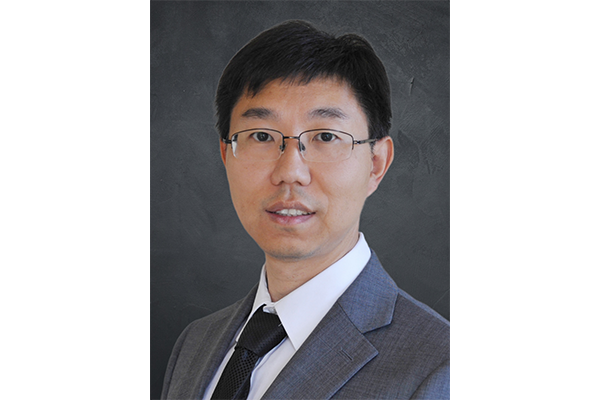
Under a new $1.2M grant from the National Science Foundation’s Fire Science Innovations program, civil and environmental engineering assistant professor Shang Liu will lead a multi-institution study of emissions from building materials burned during wildland-urban interface (WUI) fires for the project “Investigating Fire Behavior-Emission Relationships for Building Materials.” He is joined by Shichao Liu, Albert Simeoni and Reza Ziazi of Worcester Polytechnic Institute. Wildfires are a major source of air pollution and a growing threat to public health, as evidenced by a series of Canadian wildfires that blanketed much of the Northeast in a smoky haze this summer. Climate change and urban expansion are accelerating growth in WUI fires, a phenomenon where wildfires spread from nature into urban communities.
Traditional wildfires burn trees and brush, producing smoke whose emissions have been relatively well studied. However, WUI includes a wide array of novel pollution sources, as these wildfires combust building materials full of chemicals not found in nature. “When buildings burn, they can release a complex mixture of gases and particles from the plastics, insulating foams, paints, and a myriad of other materials used in construction,” explained Liu. “These create different threats to air quality and human health than a standard forest fire.”
The project aims to understand these sources better through controlled combustion of construction materials in dedicated testing facilities. “Our goal is to uncover what air pollutants are released when buildings burn during WUI fires and translate that knowledge into better emission inventories and air quality models. This will help us better understand, and ultimately better prepare for, the air quality and health impacts of these increasingly destructive fires,” said Liu.
Abstract:
Wildland-urban interface (WUI) fires, where wildfires spread into communities, are becoming more frequent and destructive as urban expansion increases the number of homes exposed to wildfires. In addition to burning vegetation, these fires consume human-made building materials, releasing complex mixtures of smoke that contain toxic pollutants not typically produced by natural wildfires. These emissions can degrade air quality, threaten public health, and complicate emergency response and recovery. However, current air quality models and emission inventories do not adequately represent smoke from burning buildings, limiting the ability of public agencies to predict smoke impacts and protect communities. This project will provide the scientific foundation needed to better characterize these emissions and improve air quality assessments during WUI fires. The research will also support the education and training of graduate students through interdisciplinary collaboration in environmental engineering, fire protection engineering, and building science, as well as engaging K–12 students through outreach activities.
This project will systematically investigate emissions from the combustion of building materials using experiments conducted across bench-, medium-, and large-scale combustion facilities. Both individual construction materials and scaled building models designed according to modern building codes will be burned to quantify aerosol and gas-phase emissions together with key fire behavior parameters. Advanced analytical instrumentation will be used to characterize emission factors, chemical composition, and physical properties under a range of combustion conditions. The study will establish quantitative relationships between fire behavior and emissions, evaluate whether emissions from complex structures can be predicted by summing emissions from individual building materials, and determine how emission characteristics vary across combustion scales. The findings will improve understanding of the combustion chemistry of human-made fuels during WUI fires, update emission inventories, and support the development of fire behavior-informed air quality models that more accurately predict the environmental and public health impacts of WUI fires.
Related NSF FIRE stories: Northeastern Joins $2M NSF-Funded Effort to Build Resilience Against Wildfire and Its Cascading Aftershocks and Interdisciplinary Team Receives NSF FIRE Grant to Study FireScreens for Wildfire Safety