Engineering for Good: A Commitment to Environmental Service in Wastewater Management
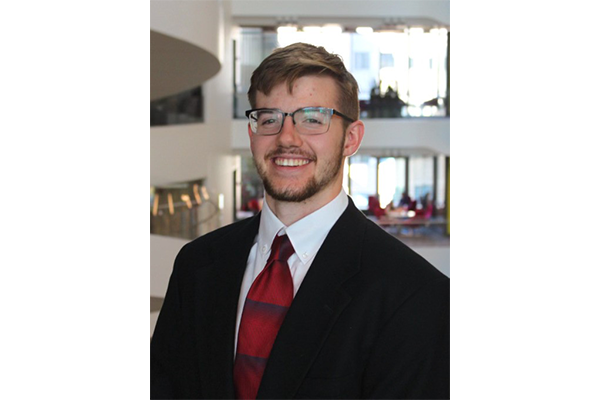
Portrait of Caleb Hagner. Photo sourced from LinkedIn.
Caleb Hagner, E’27, environmental and chemical engineering, works part-time at Practical Applications, Inc. while serving as an undergraduate research assistant. Through mentorship and hands-on experience, Hagner is committed to tackling pollution challenges at the regional level.
Caleb Hagner is completing a bachelor’s degree in environmental and chemical engineering at Northeastern, with plans to continue into a master’s degree through the PlusOne Program. Growing up in New Hampshire, he developed a deep appreciation for the natural world early on, and knew by the time he finished high school that he wanted to study civil engineering—drawn to infrastructure in a way he couldn’t quite explain. Before starting college, he took a gap year to serve in AmeriCorps as part of the National Civilian Community Corps–FEMA Corps. During that service, he inspected a wastewater treatment plant and was immediately captivated by the complexity and importance of that kind of infrastructure. The experience redirected him toward environmental engineering.
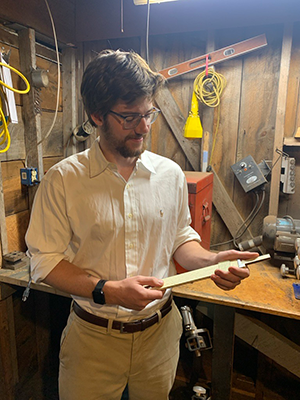
Hagner with his grandfather Ralph’s slide rule. Courtesy photo.
Northeastern had personal significance from the start: his grandfather, Ralph Johnson, graduated from the university as a mechanical engineer in 1947. Hagner felt that studying here would let him “carry on my grandfather’s legacy” and maintain a connection to someone who passed away when he was young. When he toured the campus, the feeling was confirmed. “It felt like home,” he says, “like a place I could see myself in.” The strength of the civil and environmental engineering program—and the caliber of its faculty—further solidified his decision. He began as an environmental engineering major and later added chemical engineering to deepen his focus on the chemical processes involved in waste treatment.
Hands-On Experience
Hagner has gained experience in both academic research and professional practice, and each has shaped him differently. In the research space, he works as an undergraduate research assistant in the Water Resources and Ecohydrology Lab (WRELab) at Northeastern. His primary contribution has been to RAISE, a National Science Foundation–funded project investigating how flooding patterns in Maine will change over the next thirty years. The project uses computational modeling to examine how land development, dam removal, and climate change will collectively shift flood conditions. Hagner’s work centers on hydrologic routing—modeling the movement of water through rain runoff and river systems—using Python. The project also includes a community-focused component, combining scientific modeling with stakeholder interviews to build a disaster preparedness model grounded in local knowledge.
One of the most lasting lessons from this work has been the value of clear documentation. Hagner has relied on tools built by other researchers and experienced firsthand how frustrating it is when documentation is incomplete or unclear. That has made him meticulous about documenting his own work so that whoever picks it up next can do so without confusion or delay.
On the professional side, Hagner completed a co-op at Practical Applications Inc., an industrial water and wastewater company, working as a chemical engineering intern. The role involved consulting on projects ranging from stormwater pollution prevention to wastewater permitting and the design of new treatment systems. The experience gave him exposure to the full breadth of the industry and confirmed his commitment to the wastewater sector. When the co-op ended, he stayed on in a part-time capacity with the compliance team, inspecting and servicing treatment systems several days a week. Working almost entirely in the field has sharpened his ability to communicate clearly between clients and supervisors, ensuring that everyone has what they need to move forward.
Extracurriculars
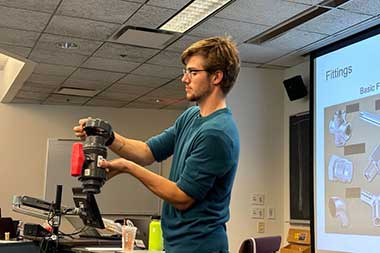
Hagner giving a lecture on pipe and valve selection during EWBootcamp. Courtesy photo.
A core belief for Hagner is that engineering is fundamentally a form of public service. “Engineering without service is no longer engineering,” he says—and his involvement on campus reflects that conviction. He has been a member of Engineers Without Borders for three years, serving as both treasurer and design lead on a project in Uganda aimed at creating a community water system in Nakyenyi Parish. He has contributed to the technical design and managed the financial side of the project—tracking donations, overseeing expenses, and preparing quarterly reports. This summer, the team plans to travel to Uganda to help bring the design to life. The work has taught him how to collaborate across time zones, make steady progress under logistical constraints, and delegate in ways that account for everyone’s schedules and commitments.
Hagner has also been deeply involved in Northeastern University Solar Decathlon, a club built around ten design and engineering contests focused on solar energy and sustainable building. In his first year, the team placed fourth in a national competition, but has since shifted toward community-focused work. Recent projects have included architecture and engineering consulting for the Ethiopian Evangelical Church in Roxbury—helping the congregation pursue sustainability upgrades with attention to existing conditions and cost. As a project co-lead this year, he has helped guide the team in their current design challenge: a timber-forward vision for rural fire stations that prioritizes the health and safety of firefighters.
Working across disciplines has been one of the most valuable aspects of this experience. Communicating a shared goal to students with different technical backgrounds—architects, engineers, designers—requires a different kind of clarity than working within a single field. It has also taught him something about leadership more broadly: “learning how to manage projects and people means you have to learn how to manage yourself as well.” Understanding his own limits and tendencies has made him a more empathetic collaborator, and he has come to appreciate that “the way you motivate, inspire, and support somebody is completely different from the next person.”
Mentorship and Advice
While Hagner has become a resource for his own peers, he is equally grateful for the mentors who have supported him. He highlights Teaching Professor Annalisa Onnis-Hayden, vice chair for undergraduate CEE studies, as a consistent and invaluable presence. With deep expertise in the wastewater industry, she has been a reliable guide as Hagner explores his career. Beyond professional advice, he describes her as “easy to talk to, and one of the kindest and most understanding people I know”—always accessible to students regardless of what they need. She was also his first PEAK award mentor and helped introduce him to undergraduate research.
He also credits Assistant Professor James Dennedy-Frank, who runs the WRELab, as a phenomenal mentor. Their weekly meetings have covered everything from project progress to personal challenges like managing stress. Hagner particularly values the balance Professor Dennedy-Frank strikes between providing support and granting independence—a balance that has helped him grow both as a scientist and as an engineer. “He’s been a role model not only for me, but for any student he takes under his wing,” Hagner says.
As he approaches the end of his bachelor’s program, one piece of wisdom he wishes he had internalized earlier is that it’s okay to try something and discover it isn’t for you. “There are so many things to try, and you can’t do everything,” he says. Moving on from a group or a project “isn’t a rebuke to that professor or organization—it’s just an understanding of where your interest really lies.” He encourages younger students to explore widely, because in his experience, that openness has led to some of his most meaningful personal and professional discoveries.
Future Plans
This summer, Hagner will begin his second co-op at Wright-Pierce, a municipal wastewater consulting firm. After completing his bachelor’s degree, he plans to pursue a part-time master’s in environmental engineering through the PlusOne Program while returning to industry as a process engineer in wastewater design. One of the problems he is most motivated to address is PFAS contamination—so-called “forever chemicals” that have become pervasive in wastewater systems. He hopes to return to New Hampshire to tackle this challenge regionally, getting ahead of what he believes “could be the next asbestos, the next lead.” With the technical foundation, field experience, and genuine sense of purpose he has developed at Northeastern, Hagner is well equipped to make a meaningful impact in the municipal wastewater industry.