Building Low Cost Digital Twins to Accelerate Robotics Innovation
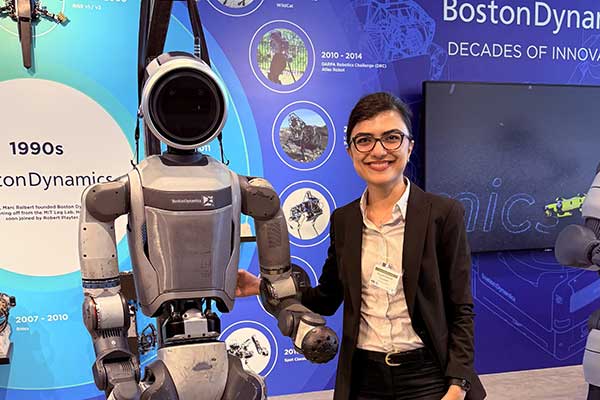
Fatemeh Ghoreishi, an Assistant Professor of Civil and Environmental Engineering, jointly appointed with the Khoury College of Computer Sciences, was awarded $281,660 from the Massachusetts Technology Collaborative’s Innovation Institute, supporting a $352,075 project with matching cost-share, for OpenBayes Twin-in-a-Box: A Public, Decision-Grade Digital Twin and Manufacturable Compliant Manipulation Module for Massachusetts Logistics and Manufacturing. The award, granted under the institute’s Robotic Digital Twin Initiative, was one of six delivered across Massachusetts.
The award was announced at a ceremony at Boston Dynamics, featuring Eric Paley, Secretary of Economic Development for the Commonwealth.
“Robotic Digital Twins are advanced simulations that replicate a robot’s ability to sense and move in its environment,” The institute explains on its website. Digital twins offer a cost-effective and safe manner for training and testing robotics. “Digital twins enable users to work with robots in a zero-risk environment because they are both low-cost and unbreakable.”
Ultimately, a digital twin is still a digital environment, and distinctly different from the real world. Novel engineering is needed to improve trust and accuracy. The project will develop an open digital twin library with physics-based models, Bayesian calibration tools, uncertainty estimates, and benchmark manipulation tasks. A key planned deliverable is a validation report that will document where the digital twin can be trusted, where its limits are, and how uncertainty should be interpreted by external users.
“Digital twins can accelerate robotics innovation, but only if users understand when the simulation can be trusted,” explained Ghoreishi. “With OpenBayes Twin-in-a-Box, we are building an open, uncertainty-aware digital twin that not only predicts robotic behavior but also shows what it knows, what it does not know, and where it can be used with confidence.”