Bridging Engineering and Policy Through Climate Finance

Portrait of Aayushi Mishra. Courtesy photo.
Aayushi Mishra, PhD ’28, civil and environmental engineering, researches how climate change affects the municipal bond market, with the goal of disrupting what she calls the “Climate Debt Doom Loop.” After graduation, she plans to return to industry to continue working on behalf of communities most affected by climate change.
Aayushi Mishra is a doctoral candidate in civil and environmental engineering at Northeastern, with a focus on public policy. Before her PhD, she earned a bachelor’s degree in biology and environmental studies from Mount Holyoke College and a master’s in environmental science and policy from Columbia University. It was during her master’s program that she began to crystallize her interest in the intersection of climate science and public policy—drawn to the way rigorous research can shape real-world decisions. “Half the equation is technical expertise,” she says, “but the other important half is being able to translate that knowledge to impact real problems.” After completing her master’s, she spent several years in consulting at EA Engineering, helping clients work toward concrete environmental goals.
The more she worked in industry, however, the more Aayushi felt herself becoming “a generalist”—and she wanted to specialize. As she explored PhD programs in Boston, Northeastern’s interdisciplinary engineering program stood out. She had never fit neatly into a single discipline, and the opportunity to work with advisors from two different schools was a significant factor in her decision. She is now pursuing her PhD through the College of Engineering with additional guidance from the School of Public Policy and Foreign Affairs—a structure that suits both her research and the way she thinks.
Research at SDS
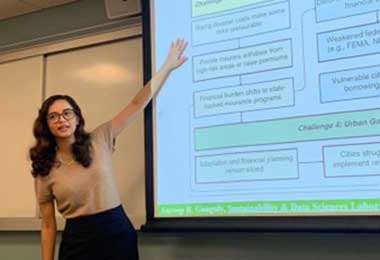
Aayushi presenting her research. Courtesy photo.
Aayushi is a graduate researcher at Northeastern’s Sustainability and Data Sciences Lab (SDS). Her recently published paper in Nature Cities examines the “Climate Debt Doom Loop” in U.S. municipalities—specifically, how climate change is priced into the municipal bond market. Municipal bonds fund the vast majority of public infrastructure, and when climate risks are factored into bond pricing, the cost of financing protective infrastructure—flood barriers, fire prevention systems—can become unaffordable for lower-income communities. Without access to affordable funding, infrastructure deteriorates, leaving those communities more exposed to climate-related damage and driving costs higher still. The paper analyzes how bond pricing shifts depending on whether climate risk is accounted for, and explores how to break the cycle, drawing on multiple U.S. cities as case studies to examine the different strategies they have used to protect their infrastructure. The work received significant media attention, including coverage in the Wall Street Journal, Politico, and Northeastern Global News.
Aayushi has since developed a follow-up paper examining a similar cycle at the sovereign level. Using Hurricane Melissa’s devastating impact on Jamaica—which decimated roughly 40 percent of the country’s GDP—as a case study, the paper analyzes the structural conditions that made such destruction possible, the likely long-term consequences, and potential pathways to disrupt the cycle going forward.
Through her research, Aayushi has represented Northeastern at a wide range of conferences and forums, including New York Climate Week, events at Harvard University, GreenBiz, the American Geophysical Union (AGU) conference, and Innovations in Climate Resilience, among others. These experiences have expanded her perspective and surfaced new collaboration opportunities. She notes that no matter how her field has shifted, Northeastern has consistently provided the resources she needed to pursue her work. The interdisciplinary nature of her program has sharpened her technical abilities considerably—and pointed them in a direction she finds genuinely impactful.
Beyond conferences, Aayushi has been invited to speak at the New York Stock Exchange’s Climate and Capital Roundtable, the California Department of Transportation, Washington State’s Floodplains by Design program, and on the Debtwire podcast The Muni Lowdown. She also had the opportunity to meet Massachusetts Governor Maura Healey at the announcement of the state’s AI Strategic Task Force.
Outside of her core research, Aayushi is a research fellow at Municipal Market Analytics Inc., a municipal finance firm. The fellowship has deepened her understanding of the bond market’s intricacies and exposed her to current issues that purely academic research can’t always surface. It has also extended her reach—bringing her research into conversation with practitioners and clients she might not otherwise have accessed. The role has generated new contributors and collaborators, offering a sharper, ground-level view of the problems her research addresses. Last semester, she also co-instructed a graduate course on climate science at Northeastern, an experience she found deeply rewarding and fully in keeping with her commitment to experiential learning.
Mentorship and Perspective
Both of Aayushi’s advisors—Distinguished Professor Auroop Ganguly and Associate Professor Serena Alexander—have been important sources of support and guidance. She appreciates the space they give her to explore different directions while offering substantive feedback that keeps her work rigorous. Having two advisors with distinct perspectives has enriched her research in ways she didn’t fully anticipate. She particularly admires Professor Ganguly, who leads SDS, for his ability to be a highly accomplished specialist while remaining genuinely curious about adjacent fields. He was working with artificial intelligence years before it entered the mainstream, and she describes him as “always two steps ahead”—both in terms of emerging lab technologies and broader trends. She credits him with modeling what it looks like to run a productive research enterprise while keeping it relevant and forward-looking.
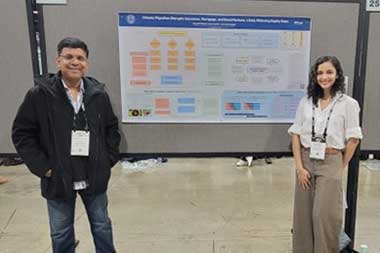
Aayushi and her advisor (Dr. Ganguly) next to her research poster. Courtesy photo.
Aayushi also highlights Dr. Evan Kodra, who established the Lizzy Warner Fellowship from which she has benefited. She describes him as “a constant pillar of support” throughout her doctoral research. It was Kodra who first introduced her to the municipal bond market through his startup, risQ, offering her a vantage point that bridged industry and academia—and opening doors to prominent figures in the field. She continues to reach out to him for guidance and is grateful for the mentorship he has offered throughout.
Over the course of her PhD, Aayushi has developed a renewed appreciation for industry—and a conviction that the gap between academic research and industry practice in climate finance is both significant and worth closing. Her fellowship helped her see how much faster industry can move, and she has since made a point of including industry experts in her research process, finding that their input often surfaces the most pressing gaps in the academic literature. She has formalized this approach by helping establish a consortium to examine those differences directly. She believes other engineering disciplines would benefit from a similar model.
Looking Ahead
After completing her PhD, Aayushi plans to return to industry, either in the municipal finance sector or at the sovereign level. She is less focused on where she lands than on the mission of the organization she joins—she wants to work somewhere that is genuinely committed to equity between communities, recognizing that meaningful climate solutions must be tailored to local conditions and needs. Her motivation is impact: using her platform to advance societal good. With the depth of experience, interdisciplinary perspective, and drive she has demonstrated throughout her doctoral work, Aayushi is well positioned to be an innovative and consequential voice in the climate finance field.