Fulbright-Bound: How a Northeastern Professor Is Using Robots to Unlock Iceland’s Ancient Hydrothermal Vents
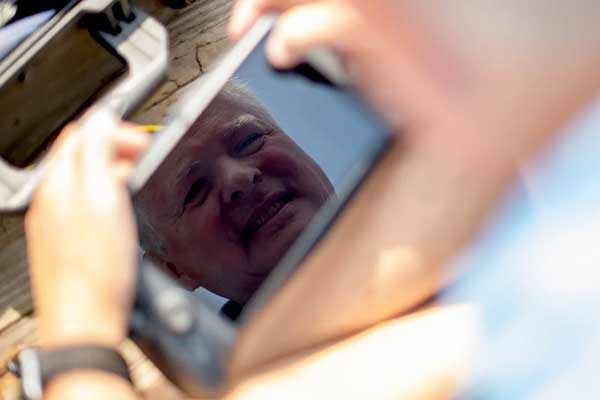
Mark Patterson, a professor of marine and environmental sciences, will embark on a Fulbright this fall to study Icelandic hydrothermal vents. Photo by Matthew Modoono/Northeastern University
Second-time Fulbright recipient and MES/CEE Professor Mark Patterson has plans to study the hydrothermal vents of Iceland, hoping to examine how the marine ecosystem is responding to microplastics and ocean acidification.
This article originally appeared on Northeastern Global News. It was published by Tanner Stening.
Professor receives Fulbright to explore one of the world’s most unique hydrothermal vents
If you dive into the frigid Arctic water of a fjord called Eyjafjörður off the northern coast of Iceland, you’ll discover something out of a Jules Verne novel: towering white hydrothermal vents, some towering hundreds of feet from the seafloor.
By producing a steady flow of warm freshwater and food for sea creatures, the vents create a rare underwater oasis that supports dense marine life — including cod, kelp, and all manner of invertebrates — in the otherwise harsh Arctic environment, said Mark Patterson, professor of marine and environmental sciences and civil and environmental engineering at Northeastern.
“You’ve got sponges and corals and sea anemones and mussels and clams and bryozoans — these weird invertebrates that filter feed — and countless other creatures,” said Patterson, who also has appointments at the Global Resilience Institute, the Coastal Sustainability Institute and the Institute for Experiential Robotics.
Formed by superheated glacial water from the last ice age, the hydrothermal vents have been bubbling beneath the fjord for centuries, Patterson said. They release freshwater of up to 176 degrees that’s been trapped beneath Iceland’s volcanic crust for some 11,500 years, he said. Some of these systems can reach temperatures of more than 700 degrees.
Patterson, who is traveling to Iceland this fall to study these structures, described the site, known as the Strýtan field, as something of a “national treasure.”
“It’s probably one of the top 10 scuba dive spots on the planet, if you’re into diving in cold water,” Patterson said. “You hear all this bubbling noise; it’s like being in a giant carbonated soft drink as you swim around.”
But he is interested not only in how the vents sustain marine life but also in how they act as a buffer against changing ocean conditions. An excess of carbon dioxide emitted from the burning of fossil fuels and other human activity is being absorbed by the world’s oceans and making the water highly acidic, something known as ocean acidification. But the vents release unusually alkaline freshwater into the fjord, helping to maintain the chemistry of the ocean around the vents and nurture the thriving tapestry of sea life that depends on them.
This quality also means that such hydrothermal vents offer scientists a rare underwater laboratory for studying how marine ecosystems might respond to ocean acidification and other ensuing effects of climate change.
Patterson has a track record of using cutting-edge robotics to study some of the planet’s most remote and fragile marine ecosystems, including the Strýtan field. That work has now earned him a prestigious opportunity: He was recently named a Fulbright-NSF Distinguished Arctic Research Scholar at the University of Iceland. Once there, he is planning to use marine robotics, advanced sensors and machine learning to explore the workings of these intricate systems.
The appointment, which awards internationally recognized researchers the opportunity to conduct collaborative research abroad, places Patterson in rare company at Northeastern. Of Northeastern’s 117 faculty Fulbright recipients, only 10 have received top-tier honors, such as Distinguished Scholar, Distinguished Chair or Research Chair awards — and Patterson now holds two of them, said Sierra Muñoz, an outreach program coordinator with the Department of Marine and Environmental Sciences.
Read full article on Northeastern Global News